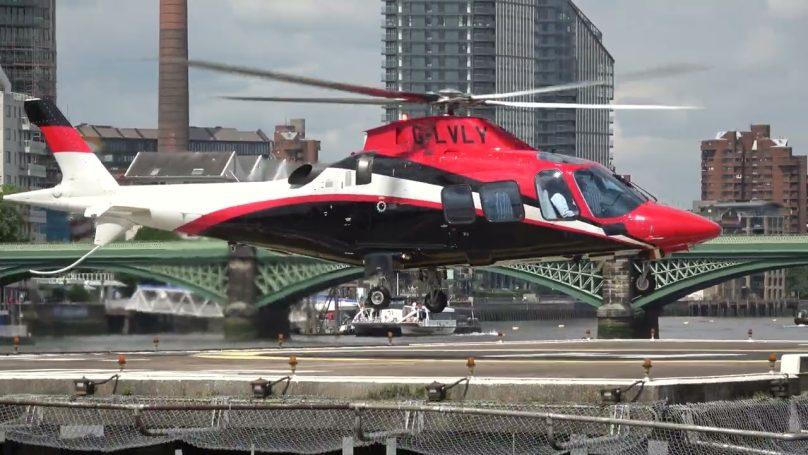
The Agusta A109 Grand (also called the AW109 Grand) is a twin-engine helicopter from the Italian maker Agusta, now part of Leonardo. Introduced in 2006 as an enlarged version of the A109, it has two Pratt & Whitney Canada PW207 engines and a lengthened cabin. On our flights it carries up to six passengers with luggage, subject to weight limits.
Where the A109 Grand comes from
The A109 family first flew on 4 August 1971 in Italy and has been in production for around forty years. The company that built it was Agusta, which became AgustaWestland and is now Leonardo, so you will see the same helicopter called A109, AW109 or simply Agusta.
The A109S Grand arrived in 2006 as the enlarged, cabin-upgraded civil version, with longer main rotor blades with a different tip design from the earlier Power version.
At a glance
| Feature | Agusta A109 Grand |
|---|---|
| Manufacturer | Agusta (now Leonardo), Italy |
| Introduced | 2006 (family first flew in 1971) |
| Engines | Two Pratt & Whitney Canada PW207 turboshafts |
| Undercarriage | Retractable wheeled undercarriage, as on most A109s |
| Passengers on our flights | Up to six, with luggage subject to weight limits |
The cabin and the luggage hold
The Grand’s cabin is lengthened compared with earlier A109s and is laid out for executive travel, with executive seating and large windows. Luggage is carried in a hold at the rear, entered through its own door, so bags travel separately from passengers. Because every helicopter has strict weight limits, we ask for passenger weights and an idea of the luggage before we confirm the aircraft.
Instrument flight and reliability
Our Agusta 109 Grand is described as IFR-capable, meaning the crew and aircraft can fly by instruments when visibility is reduced. That widens the range of weather in which a flight can go ahead, although cloud base, wind and the heliport’s own limits still apply. Having two engines also gives a margin if one engine needs to be shut down. We explain why in twin-engine vs single-engine helicopters.
When the A109 Grand suits a flight
- Business transfers from Battersea to airports such as Farnborough, Biggin Hill, Luton and Stansted.
- Race days and events, where a smart arrival and a fast return matter.
- Longer trips across the UK or to Europe, within range and weight limits.
For bigger groups, the Airbus H145 profile has more seats; for a compact aircraft that suits smaller landing sites, see the AS355 Twin Squirrel profile. Our fleet page lists everything available.
Frequently asked questions
How many passengers does the Agusta A109 Grand carry?
On our flights it carries up to six passengers with luggage, subject to weight limits.
Is the A109 Grand a twin-engine helicopter?
Yes. It has two Pratt & Whitney Canada PW207 engines.
What is the difference between the A109 and the AW109?
They are the same family. The A109 was built by Agusta, and the AW109 name came after Agusta merged with Westland. The Grand is the enlarged version introduced in 2006.
Can the A109 Grand fly in poor weather?
It is IFR-capable, so it can fly by instruments in reduced visibility, but cloud base, wind and the limits of the landing site still decide whether a flight goes ahead.
A second view of this helicopter: Agusta 109 fleet guide on helicopterhireprices.co.uk.
Plan your flight
Interested in the Agusta A109 Grand? Tell us your route and date and we will reply with a price for this aircraft. Our charter team is available 24 hours a day.